
The USMCA Didn’t End. It Just Got a Yearly Expiration Date
If you move freight between the United States and Mexico, you have probably heard some version of the headline: “The U.S. did not renew the USMCA.” It sounds dramatic, and plenty of shippers read it as the beginning of the end for duty-free trade in North America.
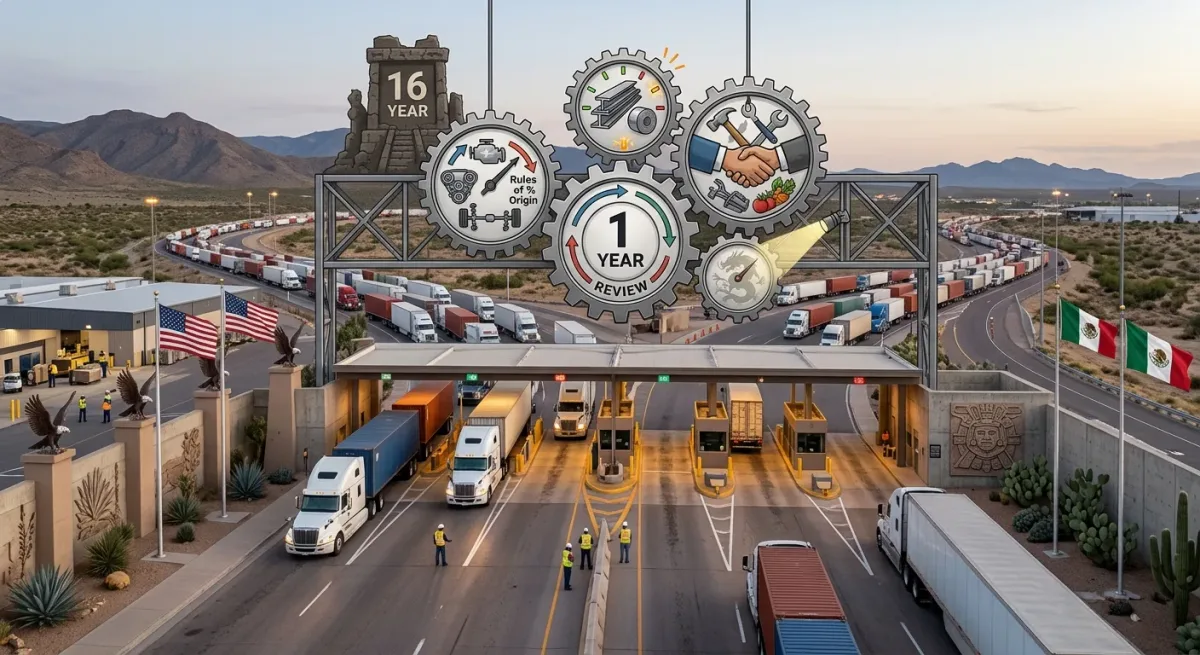
It is not. The agreement is still fully in force, your qualifying goods still cross at preferential rates, and nothing changed at the border on July 2. What did change is the rhythm of trade policy. Instead of a stable rulebook locked in for 16 more years, U.S. shippers now operate under an agreement that gets reopened every single year until 2036.
This guide explains what actually happened, what is still the same for your freight, what Washington is pushing to change, and five practical steps U.S. importers and exporters can take now, before the next round of talks lands on their lanes.
What actually happened on July 1, 2026
When the USMCA replaced NAFTA in 2020, it came with a built-in checkpoint. Under Article 34.7, the three countries had to sit down six years later and decide whether to extend the deal for another 16-year term.
That meeting took place virtually on July 1, 2026. Mexico and Canada both signaled they wanted to renew. The United States did not. U.S. Trade Representative Jamieson Greer confirmed the U.S. would not renew the agreement in its current form, and said Washington would keep engaging with both partners to address what it sees as the deal’s shortcomings and the U.S. trade deficits.
Because there was no consensus, the agreement’s fallback mechanism kicked in. The USMCA does not terminate. It stays in force until July 1, 2036, and the three countries now hold a joint review every year. At any of those reviews, they can still agree to confirm the full extension.
At the same time, the U.S. chose to negotiate with each partner separately. By late July, the U.S. and Mexico had completed three bilateral rounds covering auto rules of origin, steel and aluminum, labor, agriculture and more. A fourth round planned for late September in Washington was postponed with no new date. In other words, the clock is running, but the calendar is still unclear.
What has not changed for your freight (yet)
For day-to-day operations, the most important point is simple: the review did not immediately change any cross-border shipping requirements.
-
Preferential rates still apply. Goods that qualify under USMCA still enter Mexico duty-free, and existing certificates of origin remain valid. The same logic applies to qualifying Mexican goods entering the U.S.
-
No sudden reversion. If the agreement ever did lapse, the shift back to most-favored-nation tariffs would come with six months’ notice, not overnight.
-
Mexico has not retaliated. Unlike Canada, Mexico has not imposed retaliatory tariffs on U.S. goods.
-
Trade keeps growing. Mexico’s share of U.S. imports reached 18.2% in July, and U.S.–Mexico trade flows continued to set records.
So the trucks keep rolling. The risk is not a closed border. The risk is that rules you treat as permanent can now be rewritten on a yearly basis, and the shippers caught off guard will be the ones who assumed their paperwork was settled.
What Washington wants to change
None of the U.S. proposals are final, but they show where the rules are heading. For shippers, the most relevant asks reported so far are:
-
Tighter auto rules of origin. The U.S. wants to raise regional value content for vehicles from 75% toward 82%, and add a requirement that roughly half of the components be U.S.-made for vehicles claiming preferential treatment.
-
Limits on non–North American capital and content. Washington is pressing to restrict the share of outside investment, especially Chinese, in supply chains that claim USMCA benefits. The goal is to close what officials see as a back door for goods routed through the region.
-
Steel and aluminum stay on the table. Section 232 tariffs of up to 50% on steel and aluminum remain in force and are being used as leverage in the talks.
Even if you do not ship cars or metals, the direction matters. Trade analysts widely expect stricter proof of origin and tighter scrutiny of Chinese-linked inputs across the board. A product that qualifies today on loose documentation could be challenged under stricter rules tomorrow.
How annual reviews show up in your freight
Trade policy rarely hits a shipment directly. It shows up through costs, capacity and paperwork. Here is where U.S. shippers are already feeling it.
Documentation gets audited more often. USMCA qualification is what separates a 0% duty from a meaningfully higher tariff. A longer review window means more shippers will be audited on documents they assumed were settled. Goods that fail the rules already pay Mexico’s general duty for their tariff line.
Capacity is tighter than it looks. According to CANACAR, U.S. authorities have withdrawn B-1 visas from 25,000 Mexican freight drivers, and the pool of drivers qualified for cross-border work keeps shrinking as fourth-quarter volumes build. Spot rates have climbed above contract rates for the first time since the pandemic-era cycle, which gives carriers more negotiating power.
Uncertainty slows long-term decisions. Industry groups warn that annual reviews make long-horizon investment harder to plan, from new terminals to fleet expansion. Less investment in capacity today can mean tighter lanes tomorrow.
Changes will likely hit the Mexico corridor first. The U.S.–Mexico talks are further along than those with Canada, so any negotiated change is most likely to land on southern-border lanes before anywhere else.
Five steps U.S. shippers can take now
You do not need to wait for a final deal to protect your supply chain. These steps pay off no matter how the talks end.
-
Audit your certificates of origin. Pull every USMCA claim you file and flag the ones backed by thin evidence. Trade advisors agree this is the single most useful step right now: it protects your preferential rate today and prepares you for stricter rules later.
-
Map your non–North American content. Know where Chinese or other outside components sit in your bill of materials before an auditor asks. Model how your products would perform against the proposed 82% auto threshold if you are in or near the automotive supply chain.
-
Lock in Q4 capacity early. With cross-border driver availability shrinking, now is the time to secure capacity commitments before volumes build, and to consider consolidation where it makes sense.
-
Have more than one crossing in your plan. Laredo, El Paso and Otay Mesa remain the leading truck gateways, but September’s disruptions showed the value of flexible routing. Build backup ports of entry into your routing guide instead of improvising when a crossing slows down.
-
Work with certified, compliance-ready partners. Trusted trader programs like CTPAT in the U.S. and OEA in Mexico have become increasingly important for faster clearances. Treat trade compliance as an ongoing function, not a once-a-year fire drill.
Keep your freight moving while the rules evolve with CT Incorporated
The USMCA is not going away, but it is no longer something you can set and forget. Every annual review is a chance for the rules to shift, and the shippers who adapt fastest will be the ones with the right partner on the ground.
At CT Incorporated, we move full truckload freight across the United States, Mexico and Central America. Our team coordinates the documentation, border crossings and carrier capacity that keep your shipments compliant and on schedule, whether you are importing from Mexico’s industrial north or shipping U.S. goods south.
If you want to review how the USMCA changes could affect your lanes, or you need reliable cross-border capacity before the year-end rush, our team is ready to help.
Request a quote today and let’s plan your next shipment together.